
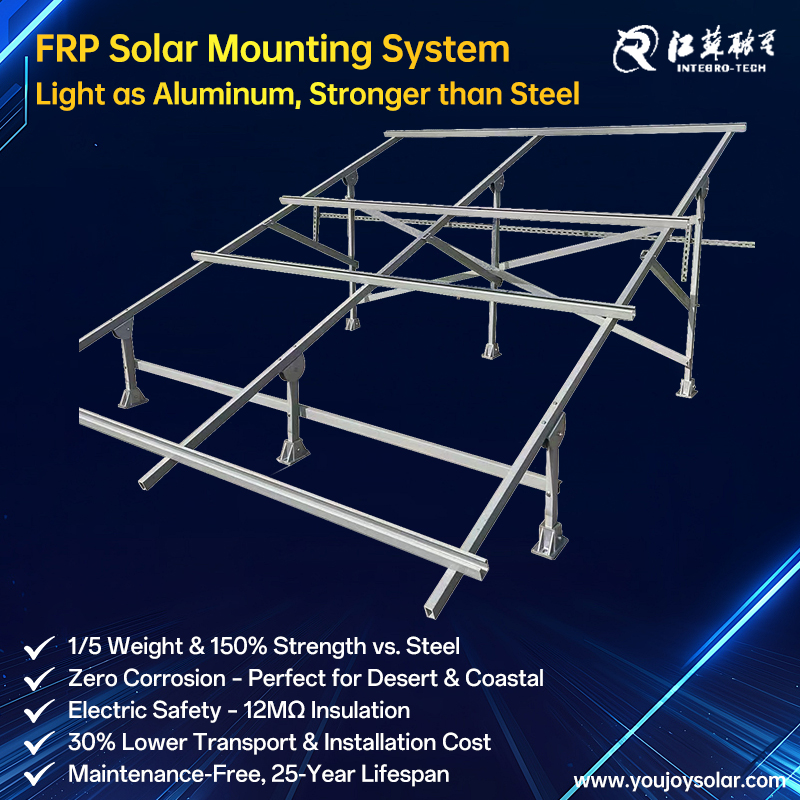
As extreme weather events—from powerful hurricanes to intense wildfires and prolonged heatwaves—become more frequent, solar assets are under increasing threat. Traditional steel and aluminum racking systems, vulnerable to corrosion, material fatigue, and thermal stress, are often inadequate for the durability demands of modern solar projects. This article explores how Fiber Reinforced Polymer (FRP) composite solar racking offers an engineered, holistic solution to build more resilient and profitable photovoltaic power plants.
The Engineering Edge: Targeted Defense Against Multiple Climate Threats
Composite solar racking is not merely a substitute for metal; it’s a fundamental redesign for resilience. Its value lies in addressing core vulnerabilities through material science:
Withstanding High Winds and Storms: Thanks to an exceptional strength-to-weight ratio, FRP racking can be up to 75% lighter than steel while providing equivalent or superior strength. This dramatically reduces wind load forces on foundations and structures, enhancing a solar farm’s stability in typhoon- and hurricane-prone regions.
Eliminating Corrosion and Degradation: The material is inherently corrosion-proof, requiring no protective coatings. It remains completely unaffected by salt spray, floodwater, or industrial pollutants, eliminating the primary cause of long-term strength degradation and maintenance-related downtime.
Combating Extreme Heat and Wildfire Risk: With a very low coefficient of thermal expansion (CTE), FRP racking minimizes expansion and contraction, protecting solar modules from thermal stress and micro-cracking. Its electrical insulation and flame-retardant properties provide an added layer of safety in areas with high wildfire risk.
Ensuring Long-Term Reliability: Resistant to UV degradation from within the material matrix and possessing excellent fatigue resistance, FRP solar mounting system is designed for a service life exceeding 25 years, matching the lifespan of photovoltaic modules.
From Cost Center to Value Asset: The Lifecycle Economics
Choosing composite solar structure is a long-term investment decision. While the initial capital expenditure may differ, the long-term value and cost savings are substantial:
| Cost Dimension | Traditional Metal Racking | FRP solar Racking | Long-Term Value |
| Anti-Corrosion Maintenance | Regular painting, repairs, part replacement | Zero Cost. No protective coatings or treatments needed. | Direct savings on significant O&M budgets. |
| Storm Damage Risk | Higher risk of deformation or collapse, leading to repair costs and production loss. | Greatly Reduced. Superior wind load performance minimizes asset damage. | Protected revenue, reducing insurance claims and power interruption. |
| Foundation & Installation | Requires heavy foundations and cranes. | Lighter weight allows for simpler foundations and faster, crane-free installation. | Savings upfront on logistics and labor costs. |
| 25-Year Total Cost of Ownership (TCO) | A recurring “cost center” with additive expenses. | Predictable, with significantly lower long-term costs. | Improved project ROI and asset value. |
Building Your Next Climate-Resilient Solar Farm
In an era of increasing climate uncertainty, the resilience of a solar farm is directly tied to its long-term financial returns. FRP composite solar brackets transforms the mounting system from a maintenance-intensive component into a durable, reliable asset engineered to withstand environmental stresses autonomously.
Take the Next Step Towards Resilience:
We offer site-specific extreme climate risk assessments and customized solar racking solutions. Visit our website to download our detailed technical whitepaper, or contact our engineering team for a preliminary feasibility analysis tailored to your project location.